



Introduction
Construction nails are fundamental fastening elements within the building and construction industry, serving as a critical component in a vast array of applications from framing and roofing to finishing carpentry. Their technical position in the supply chain is straightforward: they represent the terminal product of a steel wire manufacturing and forming process. Nails are typically produced from carbon steel wire, drawn to specific gauges, and then subjected to a heading process to form the nail head. Core performance characteristics – shear strength, tensile strength, bending resistance, and corrosion resistance – directly impact structural integrity and the longevity of completed projects. The industry is currently focused on improving nail coating technologies to enhance corrosion protection in increasingly diverse environmental conditions and reducing manufacturing inconsistencies to ensure reliable performance in automated nailing systems. A significant pain point for procurement managers is balancing cost with guaranteed performance, particularly concerning nail consistency and the potential for failures leading to costly rework.
Material Science & Manufacturing
The primary raw material for construction nails is typically carbon steel wire, with variations in carbon content influencing hardness and ductility. Common grades include SAE 1008, 1018, and higher carbon steels for specialized applications requiring greater strength. Wire diameter (gauge) dictates the nail's carrying capacity. Manufacturing begins with the production of steel wire through processes like hot rolling and cold drawing to achieve precise dimensions. The heading process, utilizing high-speed machinery, forms the nail head by compressing and deforming the wire. This process induces significant plastic deformation, demanding careful control of temperature and impact force to prevent cracking or defects. Surface treatments are crucial for corrosion resistance. Galvanization (hot-dip or electro-galvanization) is the most prevalent method, depositing a zinc coating to act as a sacrificial anode. Alternative coatings include phosphate coatings and polymer coatings offering varied levels of protection. Key parameters during manufacturing include wire tensile strength, heading die geometry, galvanization bath composition, and coating thickness. Improper control of these factors results in nails with inconsistent mechanical properties or reduced corrosion resistance. Quality control involves regular testing of wire tensile strength, nail head hardness, coating thickness, and salt spray testing to assess corrosion resistance.
Performance & Engineering
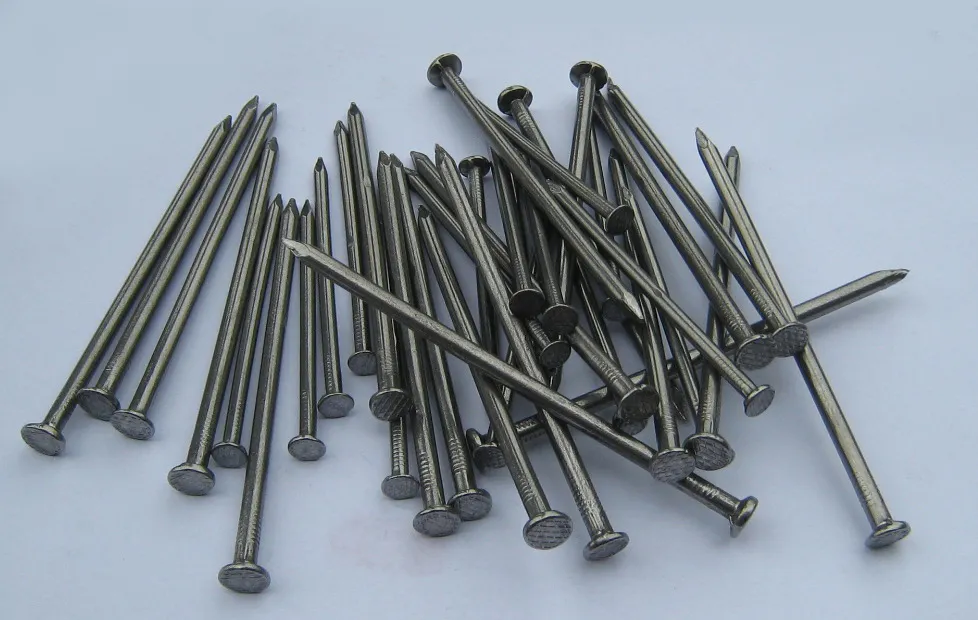
The performance of construction nails is governed by fundamental principles of mechanics and materials science. Shear strength is the primary consideration in most framing applications, determining the nail’s resistance to lateral forces. Tensile strength dictates its resistance to pull-out forces. Bending resistance is crucial for preventing nail bending during installation, particularly in hardwoods. Force analysis is critical in determining appropriate nail size and type for specific applications. This involves calculating the shear and tensile stresses acting on the nail, considering factors like wood species, load angle, and fastener spacing. Environmental resistance is paramount; corrosion can significantly reduce nail strength over time. Galvanization provides cathodic protection, but its effectiveness diminishes over time depending on environmental exposure (salt spray, humidity, pollutants). Compliance requirements vary by region. In the US, nails are often subject to standards set by the American Nail, Specialty Association (ANSA). Engineering considerations include the nail’s shank geometry (smooth vs. ring shank) and point type (diamond, chisel, blunt). Ring shanks provide increased holding power by increasing friction, while diamond points facilitate easier penetration into dense wood. Proper nail installation techniques, including correct angle and depth of penetration, are also vital for optimal performance.
Technical Specifications
| Nail Diameter (Gauge) | Nail Length (inches) | Shear Strength (PSI) | Tensile Strength (PSI) |
|---|---|---|---|
| 6d (0.113") | 2.0" | 650 | 400 |
| 8d (0.131") | 2.5" | 800 | 550 |
| 10d (0.148") | 3.0" | 1000 | 700 |
| 16d (0.196") | 3.5" | 1400 | 950 |
| Zinc Coating Thickness (µm) | 55 | 80 | 100 |
| Steel Wire Hardness (Rockwell C) | 30 | 35 | 40 |
Failure Mode & Maintenance
Construction nails are susceptible to several failure modes. Shear failure occurs when the nail’s shaft buckles under excessive lateral load. Tensile failure results from the nail being pulled out of the wood. Bending failure occurs when the nail bends excessively during installation or under load. Corrosion is a significant long-term failure mechanism, leading to weakening of the nail material and eventual failure. Hydrogen embrittlement can occur during galvanization, reducing ductility. Fatigue cracking can initiate from stress concentrations at the nail head or point, particularly in applications subject to cyclic loading. Delamination of the zinc coating exposes the underlying steel to corrosion. Maintenance of nailed connections is typically limited to visual inspection for corrosion or signs of loosening. Prevention is key; proper selection of nail type and coating, correct installation techniques, and periodic inspection for environmental damage can significantly extend service life. In severe cases of corrosion, replacement of the nails may be necessary. For critical structural applications, utilizing corrosion-resistant fasteners like stainless steel nails may be warranted despite the higher initial cost. Regular application of protective coatings to the wood surrounding the nails can also help mitigate corrosion.
Industry FAQ
Q: What is the difference between smooth shank and ring shank nails, and when should each be used?
A: Smooth shank nails are suitable for general-purpose construction where holding power isn’t critical. Ring shank nails feature helical rings along the shank, increasing friction and significantly enhancing holding power, particularly in applications subject to vibration or where pull-out resistance is paramount, such as siding installation or decking.
Q: How does the thickness of the zinc coating impact corrosion resistance?
A: A thicker zinc coating provides greater cathodic protection, slowing down the corrosion process. However, excessively thick coatings can be brittle and prone to cracking. The industry standard typically falls between 55-100 µm, with higher thicknesses recommended for marine or highly corrosive environments.
Q: What is the impact of using nails in pressure-treated lumber?
A: Pressure-treated lumber contains chemicals that can accelerate the corrosion of standard carbon steel nails. It is crucial to use nails specifically designed for use with pressure-treated lumber, typically featuring hot-dip galvanization or stainless steel construction.
Q: What nail gauge is appropriate for framing a typical residential wall?
A: 8d or 10d nails are commonly used for framing residential walls. The specific gauge will depend on the lumber thickness and local building codes. Consulting local building regulations is essential for ensuring compliance and structural integrity.
Q: How can I identify a nail that is prone to failure due to hydrogen embrittlement?
A: Hydrogen embrittlement is difficult to detect visually. Signs can include premature cracking or breakage, particularly during installation. A reputable manufacturer will have quality control processes in place to minimize the risk of hydrogen embrittlement. Purchasing from trusted suppliers is crucial.
Conclusion
Construction nails, despite their seemingly simple design, are critical components impacting the structural integrity and longevity of buildings. Understanding the material science, manufacturing processes, and performance characteristics of nails is essential for informed procurement and proper application. The selection of appropriate nail size, gauge, shank type, and coating depends on the specific application, environmental conditions, and applicable building codes.
Future advancements in nail technology will likely focus on developing more durable and corrosion-resistant coatings, optimizing nail geometries for increased holding power, and implementing more robust quality control measures during manufacturing. A continued emphasis on proper installation techniques and adherence to industry standards will be crucial for ensuring the reliable performance of nailed connections throughout the service life of a structure.